
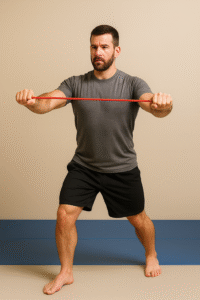
Thoracic mobility for BJJ over 40 is one of the most important — and most overlooked — parts of staying healthy on the mats. When the thoracic spine (your upper and mid-back) loses its ability to rotate, extend, and flex properly, your entire jiu-jitsu game becomes harder, stiffer, and more painful.
You feel it everywhere:
- Frames collapse under pressure
- Shoulders round forward
- Neck and lower back absorb too much force
- Passing posture falls apart
- Guard retention slows down
- Breathing becomes shallow during rolls
- Everything feels “tight” and heavy
For older grapplers, this isn’t weakness — it’s mobility loss.
And the thoracic spine is where most of that loss hides.
The good news?
Thoracic mobility for BJJ over 40 responds extremely well to the right kind of work. You don’t need extreme yoga flexibility. You don’t need to bend in half. You just need safe, controlled thoracic rotation and extension drills that directly improve your BJJ performance.
This guide gives you the full blueprint:
- Why thoracic mobility drops quickly with age
- How a stiff thoracic spine destroys your posture and movement
- The exact thoracic ranges BJJ demands
- The best thoracic mobility drills for older grapplers
- A pre-class thoracic warm-up
- A 10-minute daily routine
- A weekly over-40 structure that works
- Strength training that supports thoracic function
- Signs of improvement
- Red-flags that mean you should get checked by a clinician
This is the most complete, practical guide to thoracic mobility for BJJ over 40 — built specifically for older grapplers who want to move better, avoid injuries, and stay on the mats.
Why Thoracic Mobility Declines So Fast After 40
You don’t lose mobility because you’re old.
You lose mobility because of everything you’ve done leading up to now.
1. Decades of sitting
Desk work, driving, downtime — your thoracic spine rounds forward for hours every day. Over time, it loses the ability to extend and rotate.
2. Chest-dominant lifting
Bench press, dips, push-ups — great exercises, but they tighten the front while weakening the upper back’s ability to extend and rotate.
3. Older shoulder injuries
Shoulder pain almost always forces the thoracic spine to compensate. If your shoulder has been injured before, you’ve been over-using your upper back for years.
4. Breathing changes with age
Most men over 40 breathe from their chest, not their diaphragm. This locks the ribs down and stiffens the thoracic area.
5. Stress tension
Stress sits in the traps, neck, and upper back. For older athletes with jobs, families, and pressure, this tension never truly resets.
6. BJJ posture problems
Guard passing, framing, shrimping — BJJ constantly pulls you forward and downward. Without specific thoracic work, the spine slowly adapts to that rounded shape.
Thoracic mobility for BJJ over 40 isn’t optional — it’s foundational. If you lose this range, everything downstream suffers: shoulders, neck, ribs, lower back, and even hips.
How Poor Thoracic Mobility Damages Your BJJ
A stiff thoracic spine changes the way you move. Older grapplers feel this immediately in rolling.
Here’s how restricted thoracic mobility for BJJ over 40 impacts your game:
• Frames collapse under pressure
If the thoracic spine can’t extend, your elbows flare, your shoulders cave, and your frames fold.
• Passing posture breaks
A rounded upper back kills your ability to pressure pass or keep weight centered.
• Guard retention slows down
You can’t rotate or follow opponents’ angles fast enough.
• Breathing becomes shallow
A stiff upper back stops the ribs expanding. You gas quicker.
• Neck starts doing thoracic work
If the thoracic spine won’t rotate, your neck takes over — leading to chronic strain.
• Lower back compensates
Poor thoracic rotation causes excessive lumbar rotation, a major cause of over-40 lower-back pain.
• Shoulders lose strength
A rounded thoracic spine changes scapula mechanics, making you weaker in posting, framing, and grip fighting.
When the thoracic spine stops moving, it forces the rest of your body to absorb stress it was never designed to handle.
Fixing it restores the natural flow and strength of your jiu-jitsu.
The Thoracic Ranges That Matter Most for BJJ
Thoracic mobility for BJJ over 40 comes down to three key actions:
1. Thoracic Rotation
The ability to rotate through the upper back is essential for:
- Guard retention
- Side control framing
- Knee-cut passing
- Hip escapes
- Underhook battles
- Scrambling
Older grapplers lose this first — often without noticing.
2. Thoracic Extension
This is the ability to straighten and “open” the chest without arching the lower back.
Used for:
- Passing posture
- Posture in closed guard
- Standing guard breaks
- Shoulder stability
- Breathing under pressure
If you can’t extend, your entire BJJ posture collapses forward.
3. Rib-Cage Expansion & Flexion
This supports:
- Deep breathing
- Bracing
- Rotational power
- Safe spinal movement
- Absorbing pressure while framing
It’s subtle, but vital for older grapplers who feel “compressed.”
The Best Thoracic Mobility Drills for BJJ Over 40
These drills improve thoracic mobility without stressing the lower back or shoulders — designed specifically for older grapplers who need safe, functional rotation and extension.
High-Value Thoracic Mobility Drills for BJJ Over 40
These drills create real, usable thoracic mobility for BJJ over 40. They improve your ability to rotate, extend, frame, breathe, and maintain posture during rolling — without stressing the neck or lower back.
They are simple, safe, effective, and designed specifically for older grapplers.
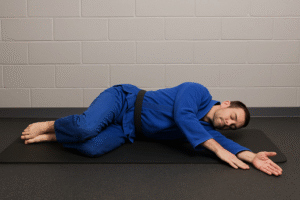
1. Open Book Rotations
One of the best drills for restoring thoracic rotation.
How to do it:
Lie on your side with knees bent. Arms stacked. Open your top arm across your body, rotating your chest toward the floor behind you.
Why it works:
- Restores thoracic rotation
- Reduces lumbar compensation
- Improves guard retention angles
- Frees up breathing
Prescription: 2 sets × 6–10 reps each side
2. Thread the Needle (Thoracic Version)
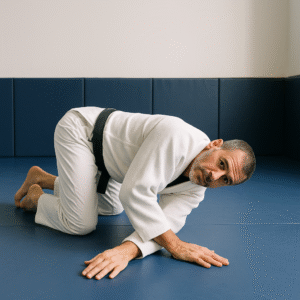
Gentle and safe for stiff backs.
How to do it:
Start on all fours. Slide one arm under your body, rotating the upper back. Then reverse the motion and reach up.
Why older grapplers need it:
- Improves framing
- Reduces neck tension
- Supports side-control escapes
- Builds rotational control
Prescription: 2 sets × 6–8 each side
3. Foam Roller Thoracic Extension
Not a stretch — a controlled extension drill.
How to do it:
Place a foam roller under your upper back. Support your head, gently extend over the roller, then return to neutral.
Why it is essential for BJJ:
- Improves passing posture
- Restores extension lost from sitting
- Reduces shoulder strain
- Helps you breathe deeper
Prescription: 2 sets × 8–10 controlled extensions
4. Quadruped Rotations (Hand Behind Head)
Perfect for building rotation while maintaining a stable lower back.
How to do it:
Start on hands and knees. Place one hand behind your head. Rotate elbow toward the opposite arm, then rotate upward.
Why older grapplers love this drill:
- Improves mobility for guard retention
- Helps with underhook battles
- Builds upper back strength in rotation
- Reduces pressure passing fatigue
Prescription: 2 sets × 6–10 each side
5. Bench Thoracic Prayer Stretch
Opens the lats, upper back, and rib cage safely.
How to do it:
Kneel in front of a bench, elbows on the bench, palms up, let the chest drop as you extend the thoracic spine.
Why it helps BJJ:
- Better posture in closed guard
- Frees the shoulders for framing
- Improves rib expansion for deeper breathing
Prescription: 20–30 sec × 2–3 rounds
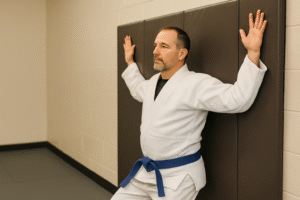
6. Wall Rotations
One of the most practical thoracic mobility drills for BJJ over 40.
How to do it:
Stand sideways next to a wall. Rotate your arms open as far as possible without letting the hips move.
Why it works:
- Builds rotation in standing positions
- Improves knee-cut passing posture
- Reduces shoulder flare during guard retention
Prescription: 2 sets × 6–10 each side
7. Side-Lying Windmills
Full-range thoracic rotation drill without stress on the lower back.
How to do it:
Lie on your side with knees bent. Trace a circle on the floor around your body, rotating your chest with it.
Why it’s great for BJJ over 40:
- Improves smooth rotational movement
- Reduces upper-back tightness
- Helps with scrambles and transitions
Prescription: 1–2 sets × 6–8 per side
8. Cat-Cow (Thoracic Version)
Simple but essential.
How to do it:
Move between gentle flexion and extension while keeping the movement focused on the upper back, not the lower spine.
Why older grapplers should do it:
- Restores basic motion
- Lubricates stiff thoracic joints
- Relaxes protective tension
Prescription: 1–2 minutes
A Five-Minute Thoracic Warm-Up Before BJJ
If you’re over 40, you cannot skip this. Thoracic mobility for BJJ over 40 is heavily influenced by how you prepare your spine before rolling. A stiff thoracic spine makes you slow, weak, and vulnerable to neck and shoulder strain.
Do this before every BJJ class:
- Open book rotations: 4 per side
- Bench prayer stretch: 20 seconds
- Thread the needle: 4 per side
- Quadruped rotations: 4 per side
- Cat-cow: 20–30 seconds
Five minutes — and your posture, frames, and guard retention immediately improve.
Ten-Minute Daily Routine (Over-40 Friendly)
Consistency beats intensity.
A short thoracic routine, done daily or every other day, is far more effective than doing a long session once a week.
Daily Routine (10 minutes):
- Foam roller extensions — 1×10
- Open book — 1×8 each side
- Bench prayer stretch — 20–30 sec
- Quadruped rotations — 1×8
- Windmills — 1×6 each side
Benefits for older grapplers:
- Better posture
- Stronger framing
- Easier breathing
- Reduced neck strain
- Improved guard retention angles
- Less shoulder pain
- Faster recovery
This is the routine that frees older grapplers from feeling “compressed” and stiff.
Weekly Structure for Thoracic Mobility
Older grapplers need a plan that fits into life — not one that takes over your life.
Monday:
BJJ + 5-minute thoracic warm-up
Tuesday:
Daily thoracic routine (10 minutes)
Wednesday:
BJJ
Add 2–3 thoracic drills after rolling (optional)
Thursday:
Strength training + thoracic finisher
Friday:
BJJ + 5-minute warm-up
Saturday:
Optional recovery mobility (5–8 minutes)
Sunday:
Rest or gentle cat-cow + open books
This structure keeps your thoracic spine moving throughout the week without overwhelming your time or recovery.
Strength Training That Supports Thoracic Mobility for BJJ Over 40
Strength training isn’t the enemy of mobility — it’s one of the best ways to lock in the new range you earn. Older grapplers often lose thoracic mobility when they become stronger in limited patterns and weaker in rotational or extension patterns.
These strength exercises reinforce thoracic mobility for BJJ over 40 while keeping your shoulders and spine safe.
1. Band Pull-Aparts
Improves upper-back stability and strengthens the postural muscles that hold your thoracic spine in good alignment.
Why it matters for BJJ:
- Stronger frames
- Better posture during passing
- Less shoulder rounding
Work: 2×15–20
2. Seated Cable Rows (Neutral Grip)
Encourages thoracic extension while building upper-back strength.
BJJ benefits:
- Improved posture in closed guard
- Stronger pulling mechanics
- Better grip-fighting alignment
Work: 3×8–12
3. Face Pulls
One of the best accessory lifts for older grapplers.
Why it works:
- Strengthens scapular stabilizers
- Offsets decades of forward posture
- Reduces neck tension
- Supports thoracic rotation
Work: 2–3×12–15
4. Landmine Rotations
A powerful but safe way to train thoracic rotation with resistance.
Why it helps:
- Builds rotational power for passing
- Improves scrambling control
- Teaches controlled rib movement
Work: 2×6–10 each side
5. Reverse Hyperextensions
Strengthens the posterior chain while unloading the spine — ideal for older grapplers with stiff backs.
Benefits:
- Frees up lower-back tension caused by poor thoracic rotation
- Supports better breathing mechanics
- Improves hip–spine coordination
Work: 2–3×12–15 (light)
6. Kettlebell Arm Bars
Combines thoracic rotation with shoulder stability.
Important for BJJ:
- Improves frames
- Strengthens rotator cuff
- Restores controlled rotation
Work: 1–2×6 per side (slow, controlled)

Mistakes Older Grapplers Make With Thoracic Mobility
Most over-40 grapplers don’t struggle because thoracic mobility is “hard.” They struggle because they approach it the wrong way. Avoid these mistakes and the process becomes simple.
❌ Mistake 1: Trying to Stretch the Lower Back Instead
If your thoracic spine doesn’t rotate, your lower back tries to compensate — and stretching it only makes this worse.
What to do instead:
Mobilise the thoracic spine directly and strengthen the upper back.
❌ Mistake 2: Doing Yoga Instead of Thoracic-Specific Work
Yoga is fine, but very little of it targets thoracic rotation — the range older grapplers need the most.
Do drills that match BJJ movement, not trendy flexibility routines.
❌ Mistake 3: Holding Stretches Too Long
Older tissues don’t respond well to long passive holds. Shorter holds + reps are more effective for thoracic mobility for BJJ over 40.
❌ Mistake 4: Only Doing Mobility When Something Hurts
Mobility must be proactive. Waiting for pain guarantees flare-ups.
❌ Mistake 5: Arching the Lower Back Instead of Extending the Thoracic Spine
Most men compensate during extension drills by over-arching the low back.
Fix:
Keep ribs down, move slowly, and focus on the upper back.
❌ Mistake 6: Ignoring Breathing
Shallow breathing stiffens the ribs and upper back.
Thoracic mobility improves much faster when you include rib expansion work.
Signs Your Thoracic Mobility Is Improving
If you’re consistent for 2–3 weeks, these changes show up quickly — especially for older grapplers:
✔ Frames feel stronger and don’t collapse
This is a direct result of improved thoracic extension and scapula mechanics.
✔ Your shoulders stop burning during guard retention
Your upper back is finally taking its share of the load.
✔ Neck pain decreases
Your thoracic spine is rotating instead of forcing your neck to do the work.
✔ Breathing feels easier during warm-ups and rolling
Your rib cage is finally expanding properly.
✔ Passing posture improves
You stay tall, balanced, and centred instead of rounding forward.
✔ Less lower-back tightness
Your thoracic spine is rotating and extending — reducing lumbar compensation.
✔ Arm drags, underhooks, and guard recovery feel smoother
Your frame mechanics work the way they should.
These improvements tell you your thoracic mobility for BJJ over 40 is heading in the right direction.
When Thoracic Pain Needs Professional Assessment
Mobility solves most issues, but some symptoms need proper evaluation, especially for men 40+ with a long training history.
Seek a clinician if you experience:
- Sharp rib-cage pain
- Pain radiating down the arm
- Numbness or tingling in the hands
- Electrical pain during rotation
- Persistent mid-back burning
- Sudden loss of shoulder strength
- Pain that worsens with gentle movement
- Pain that lasts more than two weeks
A sports physio who understands grappling is ideal. They’ll differentiate between rib dysfunction, nerve involvement, thoracic joint restriction, and shoulder compensation.
How to Combine Thoracic Mobility With BJJ Training
The biggest challenge for older grapplers is integrating mobility work into a busy life. You don’t need long sessions. You just need consistent, targeted work that fits around your training schedule.
Here’s how to blend your thoracic mobility for BJJ over 40 into your week without burning out.
Before Class
Use the 5-minute warm-up from earlier:
- Open books
- Thread the needle
- Bench prayer stretch
- Quadruped rotations
- Cat-cow
This prepares your spine for frames, guard retention, passing posture, and breathing under pressure.
After Class (Optional)
If you want faster progress, add one drill after rolling:
- Foam roller extensions
- Windmills
- Quadruped rotations
1–2 minutes is enough. The goal isn’t intensity — it’s signalling to your body that rotation and extension matter.
Strength Days
Do 1–2 thoracic-supporting lifts such as:
- Band pull-aparts
- Face pulls
- Seated cable rows
- Landmine rotations
These exercises increase the durability of your new range.

Long-Term Benefits for Grapplers Over 40
When you stay consistent with thoracic mobility for BJJ over 40, the benefits accumulate fast and continue for years:
✔ Stronger, more reliable frames
You won’t fold when someone drives pressure into you.
✔ Better posture under load
Passing becomes more efficient, and your back doesn’t gas out.
✔ Reduced shoulder stress
Improved scapula mechanics protect older shoulders.
✔ Less neck pain
Your neck finally stops doing work your thoracic spine should be doing.
✔ Better breathing under pressure
A mobile rib cage lets you recover mid-roll.
✔ Improved scrambling and transitions
Rotation becomes smooth instead of stiff and forced.
✔ Safer, longer training career
You won’t feel “crushed down” or stuck in a rounded posture.
For older grapplers, these changes are game-changing.
How to Know You’re Actually Improving
Track these simple checkpoints weekly:
1. Can you rotate further during open books?
Increasing range means your thoracic spine is freeing up.
2. Are your frames stronger during rolling?
Better thoracic extension = stronger posture.
3. Does your guard retention feel smoother?
Rotation quality directly affects recovery angles.
4. Is your neck or lower back less sore?
If yes, you’re reducing compensation.
5. Do you breathe easier in warm-ups?
Better rib mechanics mean better thoracic mobility.
A slow but steady improvement in these signs tells you you’re on the right path.
When to Reduce or Modify Thoracic Mobility Work
Older grapplers should back off if they experience:
- Sharp pain with rotation
- Tingling, numbness, or nerve-like symptoms
- Pain that worsens after 24 hours
- Severe rib-cage discomfort
- Pain during normal breathing
Modify, don’t quit:
- Reduce range by 30–40%
- Switch to gentler drills
- Shorten reps and holds
- Avoid end-range rotation temporarily
If pain persists, see a grappling-aware physio to rule out rib issues, facet joint irritation, or nerve involvement.
Final Thoughts
Thoracic mobility for BJJ over 40 is one of the most overlooked elements of long-term training longevity. When your upper back loses rotation and extension, your shoulders tighten, your neck overworks, your lower back compensates, and your posture collapses under pressure.
But when your thoracic spine moves well?
- You frame stronger
- You pass cleaner
- You breathe easier
- You stay healthier
- You roll longer
You don’t need extreme flexibility.
You just need consistent, joint-specific work that keeps the thoracic spine doing its job.
Do the warm-ups.
Do the daily routine.
Do the rotation and extension drills.
Give your thoracic spine what it needs, and your jiu-jitsu will feel smoother, lighter, and more controlled — no matter your age.
This is how older grapplers stay on the mats, avoid unnecessary injuries, and build a body that supports BJJ for decades to come.
Internal Links
For more recovery guidance built for grapplers over 40, explore:
External Medical References
These authoritative resources provide reliable information on joint health, spine mobility, and safe exercise guidelines:
- Harvard Health Publishing
https://www.health.harvard.edu/ - Mayo Clinic – Exercise and Mobility Resources
https://www.mayoclinic.org/ - Cleveland Clinic – Joint and Spine Health
https://my.clevelandclinic.org/
References & Medical Guidance
This article follows established principles from recognised health and training organisations.
Information is based on:
- General guidelines for safe mobility training in adults over 40
- Evidence-supported benefits of thoracic mobility and shoulder strength work
- Experience-based insights from long-term grappling and strength training
- Foundations taught in Active IQ Level 2 Fitness Instructing
This guide is not a substitute for medical advice. If you have pain, injury, or limited movement, consult a qualified medical professional or physiotherapist before starting new exercises.