
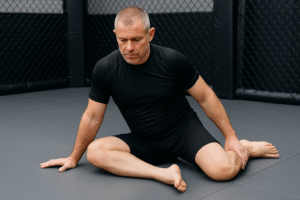
Hip mobility for BJJ becomes a major priority once you hit your 40s. Younger guys can get away with tight hips, sloppy warm-ups, and skipping mobility work, but older grapplers pay the price immediately. If your hips are stiff, your entire jiu-jitsu game slows down. Guard recovery drops, escapes feel sticky, takedowns lose power, and your lower back starts doing work your hips are supposed to handle.
This is the reality for men over 40:
If your hips stop moving well, every part of your grappling becomes harder.
You don’t need the flexibility of a gymnast. You don’t need extreme ranges. What you need is controlled, usable hip mobility for BJJ—movement that helps you recover guard, protect your lower back, improve posture in closed guard, and keep rolling without feeling sore for three days straight.
This guide gives you exactly that. It’s written specifically for grapplers in their 40s, 50s, and beyond who want to move better, stay healthier, and continue training consistently without relying on painkillers or hope.
Here’s what you’ll learn:
- Why hip mobility declines fast after 40
- The exact hip ranges BJJ demands
- How limited mobility affects your guard, passing, and escapes
- The best hip mobility drills for older grapplers
- A pre-class hip warm-up that actually works
- A realistic 10-minute daily routine
- A weekly plan that fits around work, family, and training
- Strength work that improves hip mobility instead of hurting it
- Mistakes over-40 grapplers make when trying to “stretch more”
- How to know your hip mobility for BJJ is improving
- When hip pain is a red flag that needs proper attention
This is the clearest, most practical hip mobility guide for BJJ you’ll find—built from the ground up for older men who want results, not theory.
Why Hip Mobility Declines So Fast After 40
It’s not age alone.
It’s the combination of lifestyle, training history, and accumulated damage.
1. Years of sitting
Most grapplers over 40 have spent decades sitting at work, driving, or crouched over tools. Hips stuck in flexion eventually lose the ability to extend and rotate properly. That stiffness directly affects your guard and your takedowns.
2. Old injuries that never fully healed
Tight hip flexors, impingements, groin strains, hamstring pulls, piriformis issues—none of these magically disappear with time. They quietly restrict your hip mobility for BJJ until movement becomes dysfunctional.
3. Strength training without mobility balance
Heavy squats and deadlifts build strength, but without rotational work your hips become strong in limited ranges and weak everywhere else. Grappling demands rotation, shifting angles, and lateral movement—gym training doesn’t.
4. Scar tissue and protective tension
Every injury builds scar tissue. Every flare-up teaches your nervous system to tighten the area. That protective tension reduces range of motion even if the joint itself is healthy.
5. Stress and poor recovery
Tight hips often reflect tight nervous system patterns. Men over 40 who deal with stress, poor sleep, or high workloads often carry tension directly into the hips.
6. Sedentary hours between sessions
Even active grapplers spend most of their day sitting—and stiff hips don’t magically unlock before class.
How Poor Hip Mobility Damages Your BJJ
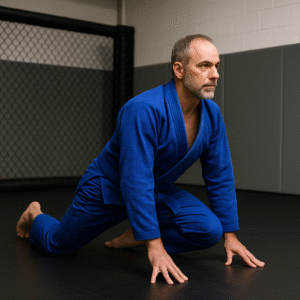
When your hips can’t rotate, extend, or flex properly, your body finds a way to cheat. And the compensation patterns are what cause most injuries in older grapplers.
Here’s what restricted hip mobility creates:
• A slower, heavier guard
Your legs don’t move fluidly, so you rely on strength instead of positioning.
• Weak hip escapes
If the hips don’t move, your spine or shoulders try to do the job.
• Lower back pain
This is the big one. Tight hips force your lumbar spine to rotate more than it should.
• Poor passing posture
If your hips can’t extend, your lower back takes the load.
• Struggling with leg pummelling
Your knees lift instead of your hips rotating properly.
• Difficulty standing up in base
Hip flexion and extension both limit the movement.
• Groin, adductor, and hip flexor flare-ups
Common in men who can’t rotate or abduct properly.
Every good grappler over 40 knows the truth:
If your hips feel “sticky,” your jiu-jitsu feels twenty years older.
The Hip Ranges That Matter Most for BJJ
Older grapplers don’t need extreme flexibility. You need controlled, functional ranges that match live rolling. Hip mobility for BJJ comes down to four key movement patterns that affect almost every technique you use.
These are the “big four” hip ranges that determine whether you feel mobile or stiff on the mats.
1. Hip External Rotation
This is the outward rotation of the thigh bone. It’s the range that protects your knees, improves your guard, and helps you recover position when someone is trying to pass.
You use external rotation for:
- Butterfly guard
- Shin-on-shin entries
- Knee shield
- K guard
- Seated guard pummelling
- De la Riva setups
- High guard adjustments
When this range is poor, you’ll notice:
- Knees collapsing inward
- Guard breaks feeling easier for opponents
- Difficulty sitting upright in guard
- Groin strain or pinch sensations
- Lower back compensating for lack of hip rotation
External rotation is one of the biggest priorities for older grapplers because it directly affects guard retention and knee health.
2. Hip Internal Rotation
Internal rotation is the inward rotation of the thigh. This is a massively underrated part of hip mobility for BJJ, especially for older grapplers who lose this range first.
You need internal rotation for:
- Escaping mount
- Retaining half guard
- Hip heists
- Lockdown sequences
- Reverse De la Riva
- Underhook escapes
When it’s limited, you’ll feel:
- Pinching in the groin
- Pain when knees fall inward
- Tension in the SI joint
- Restricted movement during half guard
- Difficulty rolling over one hip to escape
Improving this range instantly boosts your ability to create space and escape bottom positions.
3. Hip Flexion
Hip flexion is the ability to pull your knee toward your chest. This range affects guard retention more than anything else.
Used for:
- Closed guard
- High guard
- Armbar setups
- Leg pummelling
- Granby movements
- Inverting (lightly)
When flexion is tight:
- Lower back strains
- Guard feels “heavy”
- Knees can’t get close to the chest
- You compensate with spinal rounding
- Passing pressure becomes harder to manage
Older grapplers who regain hip flexion often feel their guard “comes back to life.”
4. Hip Extension
This is one of the biggest issues for men over 40. Hip extension is the ability to bring your leg behind you, opening the front of the hip.
You need it for:
- Posture in closed guard
- Takedowns
- Sprawling
- Standing guard breaks
- Strong passing base
- Technical stand-up
When hip extension is limited:
- Lower back overarches
- Hip flexors burn instantly
- Passing posture collapses
- You lean forward during rolls
- Takedown shots feel weak
This is why so many older grapplers feel their “hips are stuck forward” — because they are.
The Best Hip Mobility Drills for BJJ Over 40
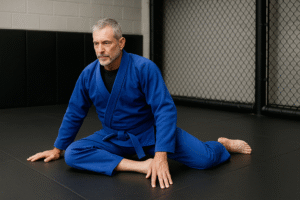
These movements are chosen specifically for older grapplers. They’re safe, effective, and build usable range that directly improves your rolling. No extreme stretches, no gimmicks — just real movement that supports hip mobility for BJJ.
1. 90/90 Transitions
This drill targets internal and external rotation — the heart of guard movement and hip escapes.
How to do it:
Sit with both legs at 90 degrees. Move slowly into the opposite 90/90 position without using your hands if possible.
Why older grapplers should do it:
It improves:
- Guard recovery
- Seated guard posture
- Hip escapes
- Half guard mobility
Work: 2 sets × 6–10 reps per side
2. Deep Lunge With Rotation
Perfect for opening the hip flexors while improving upper body rotation.
How to do it:
Step into a lunge, place hands inside the front foot, rotate the inside arm toward the ceiling.
Why it helps BJJ:
Improves:
- Passing posture
- Breathing under pressure
- Takedown entries
- Hip extension under load
Work: 2 sets × 4–6 reps per side
3. Elevated Pigeon Stretch (Safe Version)
This is a milder, safer variation than full pigeon, ideal for stiff hips.
How to do it:
Put your front shin on a bench, keep torso tall, lean forward slightly.
Why it works:
Improves:
- Butterfly hooks
- Knee shield
- Guard adjustments
- External rotation
Work: 20–30 seconds × 2 rounds per side
4. Hip Airplanes
This drill builds hip control and balance while strengthening rotation.
How to do it:
Stand on one leg, hinge at the hips, open and close the torso with control.
BJJ benefit:
Improves:
- Base stability
- Passing movement
- Scrambling control
Work: 2 sets × 4–6 per side
5. The Couch Stretch (Short Holds Only)
Older grapplers should avoid long static stretches. The couch stretch is powerful, but only when done in short, controlled bursts.
How to do it:
Place your back shin against a wall or bench. Front foot planted. Keep the ribs down and squeeze the glute of the back leg.
Why it helps BJJ:
- Restores hip extension
- Reduces lower-back compensation
- Improves posture in closed guard
- Makes takedown entries smoother
Work: 20–30 seconds × 2 per side
6. Cossack Squat (Side-to-Side Hip Opener)
This is one of the best hip mobility drills for BJJ because it builds both mobility and strength in the adductors — an area older grapplers often neglect.
How to do it:
Step wide, sit into one hip, keep the opposite leg straight. Move slowly, stay tall.
Why it improves grappling:
- Better lateral movement
- Stronger passing side switches
- Less groin tension
- Improved guard mobility
Work: 2 sets × 6 each direction
7. Supine Hip Rotations (Gentle Warm-Up)
This drill is perfect for stiff days, early mornings, or recovery sessions.
How to do it:
Lie on your back, feet on the floor. Let both knees fall side to side without forcing the movement.
Why it works for older grapplers:
- Low intensity
- Safe for the lower back
- Loosens internal and external rotation
- Easy to do daily
Work: 1–2 minutes of continuous movement
A Five-Minute Hip Warm-Up Before BJJ
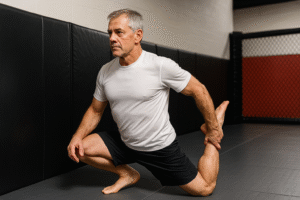
Every man over 40 should warm up their hips before rolling.
Not doing so is one of the fastest ways to injure yourself and ruin a week of training.
This warm-up is fast, simple, and directly improves your hip mobility for BJJ.
Do this before every class:
- 6 supine hip rotations
- 6–8 × 90/90 transitions
- 4–6 deep lunge rotations per side
- 6–8 Cossack squats
- 4–6 hip airplanes (optional days)
Five minutes.
Big difference in how your hips feel during class.
Ten-Minute Daily Hip Mobility Routine (Over-40 Friendly)
If you want real long-term results, you need consistency — not long sessions.
Here is the routine you can do on non-training days:
Daily Routine (10 minutes):
- 90/90 transitions — 2×8
- Supine rotations — 1 minute
- Cossack squats — 2×6
- Couch stretch — 20–30 sec per side
- Deep lunge with rotation — 2×4
This short routine improves:
- Guard recovery
- Hip escape smoothness
- Standing posture
- Passing base stability
- Overall hip mobility for BJJ
Do this for 30 days and your hips will feel noticeably younger.
Weekly Hip Mobility Plan for Older Grapplers
You don’t need a complicated plan — you need a realistic one that works around life, work, family, and recovery.
Here’s a simple weekly layout:
Monday:
BJJ class + 5-minute hip warm-up
Tuesday:
Daily hip routine (10 minutes)
Wednesday:
BJJ class
Thursday:
Strength training + mobility finisher
Friday:
BJJ class + 5-minute hip warm-up
Saturday:
Optional light mobility (5–10 minutes)
Sunday:
Rest or 5 minutes of hip rotations
This structure gives older grapplers enough mobility work to progress without overwhelming them.
Strength Training That Supports Hip Mobility for BJJ
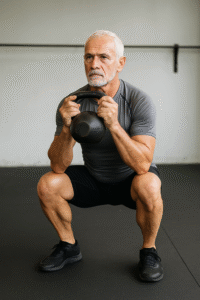
Strength and mobility work together — not against each other.
Older grapplers need strength training that reinforces the ranges they build through mobility work. This protects the hips, supports good posture, and reduces the chance of injury.
Here are the best strength movements for hip mobility for BJJ:
Goblet Squats
Teaches you to sit into the hips with control.
Romanian Deadlifts
Strengthens hamstrings and glutes without loading the spine excessively.
Kettlebell Deadlifts
Builds strong hips in a safe hinge pattern.
Hip Thrusts
Improves hip extension — crucial for posturing in guard.
Step-Ups
Builds unilateral strength and stability.
Lateral Lunges
Reinforces adductor length and lateral movement.
Cable Hip Rotations
Teaches rotational power and control for passing and scrambles.
These lifts support mobility by strengthening the new ranges you build — keeping your hips resilient and safe.
Mistakes Older Grapplers Make with Hip Mobility
Most mobility problems don’t come from a lack of stretching — they come from doing the wrong type of mobility work or doing it inconsistently.
❌ Mistake 1: Forcing Stretches
If it hurts, your nervous system tightens everything. You lose range instead of gaining it.
❌ Mistake 2: Long Static Holds
Older hips don’t respond well to extreme passive stretching. Short holds + reps work better.
❌ Mistake 3: Ignoring Pain Signals
Pain means something is wrong. Training through it makes issues worse.
❌ Mistake 4: Only Stretching When Injured
Mobility should be proactive, not reactive.
❌ Mistake 5: Doing Random Yoga Flows
Most don’t match BJJ ranges and put stress where you don’t need it.
❌ Mistake 6: Trying to Do Too Much
Mobility should be simple. The goal is controlled, usable range — not circus tricks.
How to Know Your Hip Mobility Is Improving
If you’re consistent for 2–4 weeks, you’ll start noticing clear changes in how your body moves during training. Here are the signs that your hip mobility for BJJ is heading in the right direction:
✔ You’re able to recover guard sooner
Your legs feel lighter and faster.
✔ Hip escapes feel smoother
No more feeling like your hips are made of concrete.
✔ Lower back tightness reduces
Your hips are finally doing the work, not your spine.
✔ Getting up in base feels effortless
Hip flexion and extension both improve, making transitions smoother.
✔ More confidence in your passing
Your hips stay under you, instead of collapsing forward.
✔ Knees stop flaring up during guard work
This means your hips are rotating properly instead of making your knees take the load.
✔ Your legs move independently instead of as one “block”
This is the biggest sign of improved rotation.
If you notice these improvements, your mobility work is paying off. Keep going.
When Hip Pain Needs Professional Guidance
Mobility work helps most grapplers, but some situations need proper assessment — especially for men over 40 who’ve collected years of injuries.
You should speak to a physiotherapist or sports clinician if you experience:
- Sharp joint pain
- Groin pain that increases with movement
- Pain that radiates down the thigh
- Persistent pinching during squats or guard work
- Numbness or tingling
- Hips “giving out” during movement
- Pain that lasts more than two weeks
- Pain that gets worse with rest instead of better
If your pain is deep inside the joint or linked to catching/locking sensations, get assessed.
If your pain improves with movement and worsens with inactivity, mobility work is usually safe.
A physio who understands grappling is ideal — they will give you guidance specific to hip mobility for BJJ, not generic stretching plans.
Final Thoughts for Older Grapplers
Hip mobility for BJJ isn’t about extreme flexibility or chasing uncomfortable positions. It’s about giving your body the ability to move the way jiu-jitsu demands — smoothly, safely, and without compensation.
As an older grappler, you don’t bounce back the way you did in your 20s. Your recovery needs are different. Your tissues take longer to warm up. Your joints respond better to slow, controlled movement instead of aggressive stretching.
But the upside?
Older grapplers actually respond extremely well to consistent mobility work. The improvements are noticeable and fast.
If you train 2–4 times per week and follow the mobility routines in this guide, you’ll feel:
- Less stiffness
- Better escapes
- Faster guard recovery
- Stronger passing base
- Improved balance and posture
- Fewer groin and hip flexor flare-ups
- More confidence in every position
Ten minutes a day.
Five minutes before class.
A bit of strength work each week.
This is the formula for staying on the mats — strong, mobile, and injury-free — long after younger grapplers burn themselves out.
Your hips don’t have to decline with age.
You can rebuild them.
You can protect them.
You can make them stronger than they’ve been in years.
Do the work.
Roll smart.
Stay on the mats.
Your hips will thank you every single session.
Further Reading
Check out more recovery guides built for grapplers over 40:
- Mobility & Flexibility Hub
- Injury Prevention Hub
- Cold Plunge Recovery Hub
References
This guide is supported by reputable health and wellness organisations:
These sources provide evidence-based information on mobility, aging, joint health, and safe training practices. This content is educational only and not medical advice.