
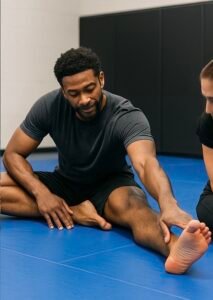
If you are over 40 and still training jiu-jitsu, you already know this: your body does not give you free range any more. Hips stay tight. Shoulders complain. Your upper back feels like it is locked in place after a long day at work. When you hit the mats, that stiffness shows up in every round. This is where the right BJJ mobility exercises come in. Done consistently, they keep you moving, reduce joint stress, and let you train hard without feeling wrecked for two days after.
These BJJ mobility exercises give older grapplers the joint freedom they need to reduce stiffness, avoid flare-ups, and move with more control during every round.
- The main reasons mobility drops after 40
- The key areas that actually matter for jiu-jitsu
- A small set of BJJ mobility exercises that cover those joints
- A five minute warm up you can repeat before every class
- A ten minute daily routine
- A simple weekly structure that fits work and family
- Basic strength ideas that support joint health
- Common mistakes that beat up older bodies
- Signs that your mobility work is paying off
You can treat this as your personal blueprint for staying on the mats for years.
Why mobility drops so hard after 40
Nothing magical happens on your fortieth birthday. What changes is the total load you have put through your body by that point. Work, lifting, old sports, previous martial arts, years of sitting, driving, and stress all add up. If you do not move well in daily life, your joints arrive at training already stiff and tired.
A few simple truths explain most of the problems:
- Connective tissue gets stiffer with age if you do not train range of motion.
- Most jobs push you into the same bad positions all day.
- Old injuries leave scar tissue and weak links.
- Heavy lifting in a few ranges can lock those ranges in place.
- Recovery is slower, so irritation hangs around longer.
On the mats that shows up as:
- Tight hips that make guard work feel slow and heavy.
- A rigid upper back that collapses when you pass from the knees.
- Shoulders that burn out when you frame or post.
- Lower back tightness after even light rolls.
- Feeling “old” during warm ups until you finally loosen a bit.
You cannot turn the clock back. You can build a body that is much better prepared for jiu-jitsu in your forties, fifties, and beyond. That starts with the right BJJ mobility exercises.
The three priorities for BJJ mobility
You do not need to stretch everything. For jiu-jitsu, three areas give almost all the return:
- Hips
- Thoracic spine (upper back)
- Shoulders
If you take care of these, most of your “old man stiffness” starts to fade.
Hip mobility: the engine of your guard and escapes
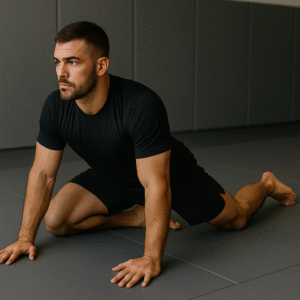
Your hips drive almost every movement in BJJ. Guard retention, hip escapes, butterfly hooks, leg pummelling, technical stand ups, and scrambles all depend on how freely your hips can flex, extend, and rotate. When hip mobility drops, older grapplers feel it fast.
Most BJJ mobility exercises start with the hips because older grapplers lose rotation and extension faster than any other range.
Common signs:
- Strain in the lower back when you play guard.
- Knees complaining instead of the hips doing their job.
- Struggle to swing your leg over during hip escapes.
- Difficulty sitting upright in closed guard without rounding.
The most important ranges are hip external rotation, internal rotation, and hip extension. You do not need extreme angles. You just need enough room to move without your knees and lower back paying the price.
Thoracic spine mobility: posture, rotation, and breathing
The thoracic spine covers your upper and mid back and anchors your ribs. When it is stiff, it drags the neck and lower back into bad positions. In jiu-jitsu, poor thoracic mobility shows up as:.
- Rounding over when you pass from the knees.
- Straining your neck when you try to look up in bad spots.
- Feeling stuck when you try to rotate under pressure.
- Shallow breathing when somebody pins your chest.
Freeing this area lets you keep posture with less effort, rotate for escapes and guard work, and breathe more calmly under pressure. It also takes a lot of stress off the lower back.
When you combine these movements with the other BJJ mobility exercises in this guide, your upper back begins to rotate and extend the way jiu-jitsu demands.
Shoulder mobility: safe frames, strong posts, and healthy joints
The shoulder joint is the most abused in grappling. Every class you ask it to frame, post, pummel, underhook, and survive submissions. If you are over 40 and have lifted weights or done physical work for years, there is a good chance your shoulders feel rough.
Warning signs:
- Pinching pain when you reach or post.
- Burning fatigue when you frame from bottom.
- A sense that the joint is “not safe” near end range.
- Needing to tap early to kimuras or Americanas.
Good shoulder mobility for BJJ does not mean you can hang from a bar for minutes. It means you have enough controlled range in the joint and shoulder blade to frame, post, and defend submissions without fear.
Shoulder-friendly BJJ mobility exercises build the controlled range needed for strong frames, safe posting, and long-term joint health.
High value BJJ mobility exercises for older grapplers
You do not need twenty different drills. You need a small group of BJJ mobility exercises you can repeat often without annoying your joints. These movements cover almost everything you need for longevity.
Hip focused drills
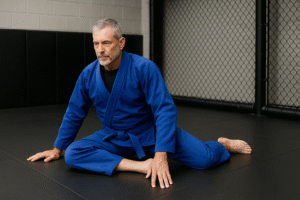
1. 90/90 hip transitions
Sit on the floor with one leg in front and one behind, both bent to around ninety degrees. Sit tall. Slowly rotate both legs to the other side without letting your hands do all the work. Pause, breathe, and repeat.
- What it trains: hip internal and external rotation.
- Why it matters: better guard retention, easier leg pummelling.
Do 2 sets of 6 to 8 transitions.
2. Deep lunge with rotation
Start in a long lunge with the back knee on the mat and both hands on the floor inside the front foot. Rotate your inside arm up toward the ceiling and turn your chest to follow. Breathe out as you rotate.
- What it trains: hip flexor mobility and thoracic rotation together.
- Why it matters: stronger passing posture and easier entries from standing.
Do 2 sets of 4 to 6 reps per side.
3. Short hold couch stretch
Set up with your back shin against a bench, box, sofa, or wall and the front foot forward like a split squat. Gently tuck your pelvis under, keep the ribs down, and lean forward until you feel a stretch in the front of the hip and thigh.
- What it trains: hip extension.
- Why it matters: better sprawls, less lower back strain during passing.
Hold for 20 to 30 seconds per side. Do not force it.
Thoracic focused drills
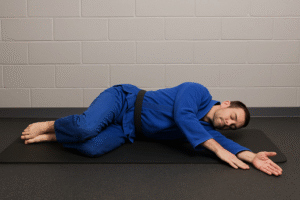
1. Open book
Lie on your side with your knees bent and stacked and both arms straight out in front of you, palms together. Keeping the knees pressed gently together, open the top arm out and back toward the floor, letting your chest follow. Breathe into your ribs, then return.
- What it trains: controlled thoracic rotation.
- Why it matters: easier escapes from chest pressure and more rotation in guard.
Do 2 sets of 6 to 8 reps per side.
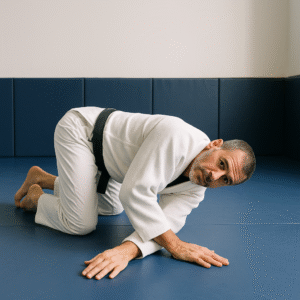
2. Thread the needle
Start on hands and knees. Slide one arm under the other, letting the shoulder and side of the head move toward the floor. Let the upper back round slightly. Either hold that position and breathe or move in and out for reps.
- What it trains: combined shoulder and upper back mobility.
- Why it matters: smoother back takes, kneeshield work, and turning to frames.
Hold for 20 to 30 seconds or do 6 to 8 slow reps per side.
3. Foam roller extensions
Place a foam roller across your upper back while you lie on the floor. Support your head with your hands. Gently extend over the roller as you breathe out, then return to neutral. Move the roller up or down a little to find tight areas.
- What it trains: thoracic extension.
- Why it matters: stronger passing posture, easier breathing, less neck strain.
Do 6 to 8 slow reps.
Shoulder focused drills
1. Scapular push ups
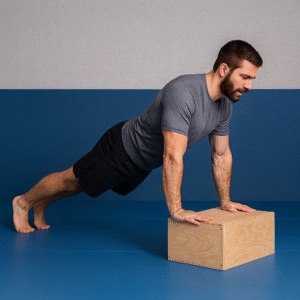
Set up in a plank position on the floor or hands on a bench if needed. Keep your elbows locked. Let your chest sink a little as your shoulder blades come together, then push the ground away so your shoulder blades spread apart.
- What it trains: shoulder blade control.
- Why it matters: stronger frames and safer posting.
Do 2 to 3 sets of 8 to 12 reps.
2. Band pull aparts
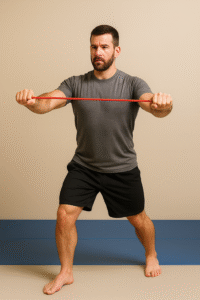
Hold a light band at shoulder height with straight arms. Pull the band apart by squeezing the shoulder blades together, then return with control. Keep the ribs down and neck relaxed.
- What it trains: upper back and rear shoulder strength.
- Why it matters: better posture for passing and standing, stronger grips.
Do 2 to 3 sets of 12 to 20 reps.
3. Wall slides
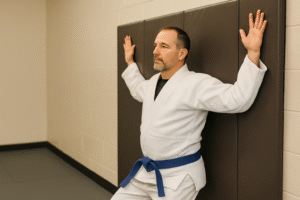
Stand with your back and head against a wall and your elbows bent, the backs of your hands touching the wall if possible. Slowly slide your hands and arms up and down, going only as far as you can without pain or losing contact.
- What it trains: safe overhead range.
- Why it matters: posting, underhooks, and overhead grips without shoulder pain.
Do 2 sets of 8 to 10 reps.
A simple five minute warm up before class
Older grapplers do not need a long warm up. They need a targeted one.
Here is a five minute sequence built around the BJJ mobility exercises above:
- 6 cat camel reps to loosen the spine.
- 6 90/90 transitions to wake up the hips.
- 8 scapular push ups to switch on the shoulders.
- 4 deep lunge with rotation per side.
- 10 band pull aparts to set posture.
Run through this before every class. You will feel looser in the first round instead of needing three rounds just to warm up.
Ten minute daily mobility routine
On non training days, or earlier in the day when you train at night, use this simple routine:
- 90/90 hip transitions – 2 x 8 per side
- Open book – 2 x 6 per side
- Scapular push ups – 2 x 8 to 10
- Glute bridge hold – 2 x 20 to 30 seconds
- Band pull aparts – 2 x 12 to 15
This covers the hips, upper back, shoulders, and posterior chain. Ten minutes a day is enough to see real change over a month if you stay consistent.
If you repeat these BJJ mobility exercises for just ten minutes a day, you create the consistency older grapplers need to stay pain-free.
Weekly structure that respects life and recovery
A realistic week for a man over 40 might look like this:
- Monday: BJJ class + five minute warm up
- Tuesday: ten minute mobility routine
- Wednesday: BJJ class + warm up
- Thursday: strength training + a few mobility drills
- Friday: BJJ class + warm up
- Saturday: optional light mobility or drilling
- Sunday: rest, walking, or very easy mobility
You can adjust the days, but keep the pattern: three BJJ sessions, two or three short mobility exposures, and at least one strength session most weeks.
A simple weekly plan that includes BJJ mobility exercises makes a huge difference for grapplers juggling work, family, and recovery.
Strength work that supports mobility
Mobility creates range. Strength keeps that range safe. For older grapplers, the best strength work is simple and repeatable. Think of building a strong base, not chasing one rep max numbers.
Useful patterns include:
- Squat or split squat variation
- Hinge variation such as Romanian deadlift
- Horizontal push such as push ups or dumbbell press
- Horizontal pull such as rows
- Loaded carries such as farmer’s carries
Two sessions a week are enough. Keep reps moderate, technique clean, and avoid grinding through sharp pain in the joints.
Common mistakes that beat up older grapplers
A few patterns keep showing up with men over 40:
- Forcing deep static stretches and holding them too long.
- Copying advanced mobility flows from much younger athletes.
- Doing nothing until a joint is already angry.
- Skipping warm ups because “there is no time.”
- Treating mobility like a one week project instead of a long term habit.
You do not need to be perfect. You do need to be consistent.
How to tell your BJJ mobility exercises are working
You will know this work is paying off when:
- You need less time to feel warm in class.
- Guard and half guard feel more comfortable.
- Your shoulders do not burn out from framing.
- Passing posture feels more natural.
- You recover faster between sessions.
- You feel less beat up the morning after hard rounds.
If none of these change after four to six weeks of regular work, adjust the plan or speak with a coach or health professional who understands grappling.
When to be cautious and get help
This guide is general and cannot replace a medical assessment. Be cautious if:
- Pain is sharp, stabbing, or clearly gets worse with each session.
- You feel numbness, tingling, or weakness down an arm or leg.
- A joint feels unstable, like it might give way.
- Pain wakes you at night or does not settle between training days.
In those cases, speaking to a qualified physio or doctor is a smart move.
Final thoughts
The right BJJ mobility exercises will not turn you into a teenager again. They will do something more important: they will let you keep enjoying the sport you love without paying for every class with two days of pain and stiffness.
You do not need an hour a day. You do need ten sensible minutes most days and a short warm up before you train. If you build that habit now, your future self will thank you every time you tie your belt and step onto the mats feeling ready instead of already defeated by your own body.
Staying consistent with BJJ mobility exercises is the easiest way for men over 40 to keep rolling hard without wrecking their joints.
Further Reading
For more recovery guides built for grapplers over 40, visit:
- Mobility & Flexibility Hub
- Injury Prevention Hub
- Cold Plunge Recovery Hub
References
The information in this guide is supported by reputable health sources, including:
These sources cover mobility, aging, joint function, and safe training practices. This article is educational only and not medical advice.